Additional Director General of Police (ADG) Bareilly Zone Ramit Sharma has launched a digital audit of the zone's entire Digital Volunteers network — using a matrix of 36 Google Form surveys distributed simultaneously across four social media platforms across all nine districts of the zone.
"We feel that an optimisation of the Digital Volunteers network is required. Before we arrive at a conclusion we have to know the perspective, experiences and suggestions of the active and committed volunteers. We will be doing a rigorous exercise to make this initiative more effective," ADG Sharma told NDD.
The comprehensive survey, being conducted this month to mark ten years of the Digital Volunteers initiative, aims to determine how many of the more than 82,000 enrolled digital volunteers across Bareilly Zone, how many are genuinely active today — and what is the precise nature of their digital reach?
The Survey architecture
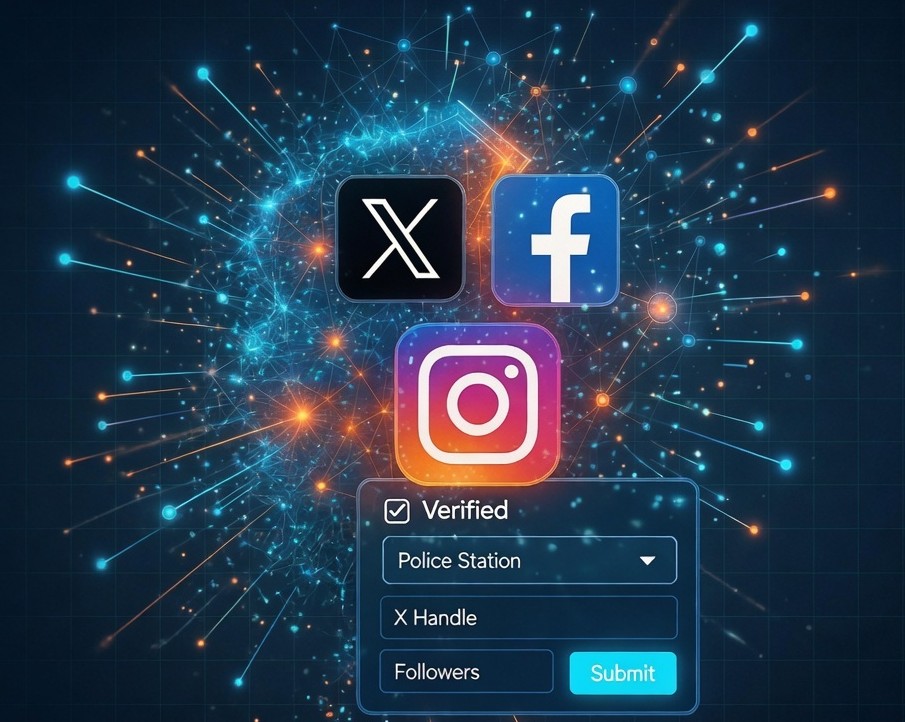
Nine districts. Four platforms — X (Twitter), Facebook official page, Facebook official account and Instagram. One dedicated Google Form per district per platform. Thirty-six forms in total — each pushed through the respective district's official social media handles.
Within each district-specific form, a dropdown menu lists every police station in that district — giving the survey station-level granularity across all 182 police stations of Bareilly Zone's nine districts: Bareilly, Badaun, Pilibhit, Shahjahanpur, Moradabad, Rampur, Amroha, Sambhal and Bijnor.
What the form asks
Three sections. The first establishes identity — name, volunteer status and police station.
The second examines social media presence — the volunteer's X handle, posting frequency ranging from "Never" to "Daily or multiple times a day," follower count and whether they follow their district police's official X handle.
The follower count question is particularly significant. Volunteers are asked to place themselves in one of five brackets: under 1,000, 1,000 to 10,000, 10,000 to 1,00,000, 1,00,000 to 10,00,000 and above 10,00,000. These brackets map precisely onto the established influencer classification framework — nano, micro, macro and mega influencers respectively.
This means the survey is not merely identifying active volunteers. It is building a classified influencer database — knowing exactly what category of digital reach each volunteer commands, station by station, district by district. A nano influencer in a rural Pilibhit police station serves a different community policing purpose than a macro influencer in Bareilly city. The survey was designed to know the difference.
The third section invites open-ended suggestions for improving the programme — giving every respondent a voice in shaping the initiative's next decade.
Why this method
A digital volunteer who cannot be reached through social media has already answered the survey's most important question — without filling in a single field. The posting frequency reveals actual behaviour. The follower brackets reveal actual reach and influencer category. Together they map the network's digital footprint — not just who is active, but what kind of digital force each active volunteer represents.
This is not an administrative audit. It is a strategic intelligence exercise.
A decade that made this necessary
The Digital Volunteers initiative was conceptualised and launched by Sharma in 2015 as DIG Meerut Range — where he also established UP Police's first Social Media Lab. Adopted state-wide in 2016, the programme grew rapidly across all 75 districts of Uttar Pradesh.
By 2025, Bareilly Zone alone had more than 82,000 enrolled volunteers. But a decade of growth might have produced drift — volunteers who had joined enthusiastically but gradually disengaged, who existed on paper but not on any platform. The March 2025 survey intends to measures that drift and will use the measurement to build something sharper as the programme enters its second decade.
What happens next
Respondents who fill up the survey form will be scrutinised by the Social Media team of Bareilly zonal office. Active and engaged volunteers — classified by their influencer category and platform presence — will be interviewed telephonically after verification of their details. Members of the zonal team told NDD that each response will be manually verified before telephonic follow-up — a process they expect to complete within five months. The selected digital volunteers will then be called for a physical meeting later this year, bringing the network's most committed members together for a strategic session as the initiative turns ten. The date and venue of the planned meeting have not yet been announced.