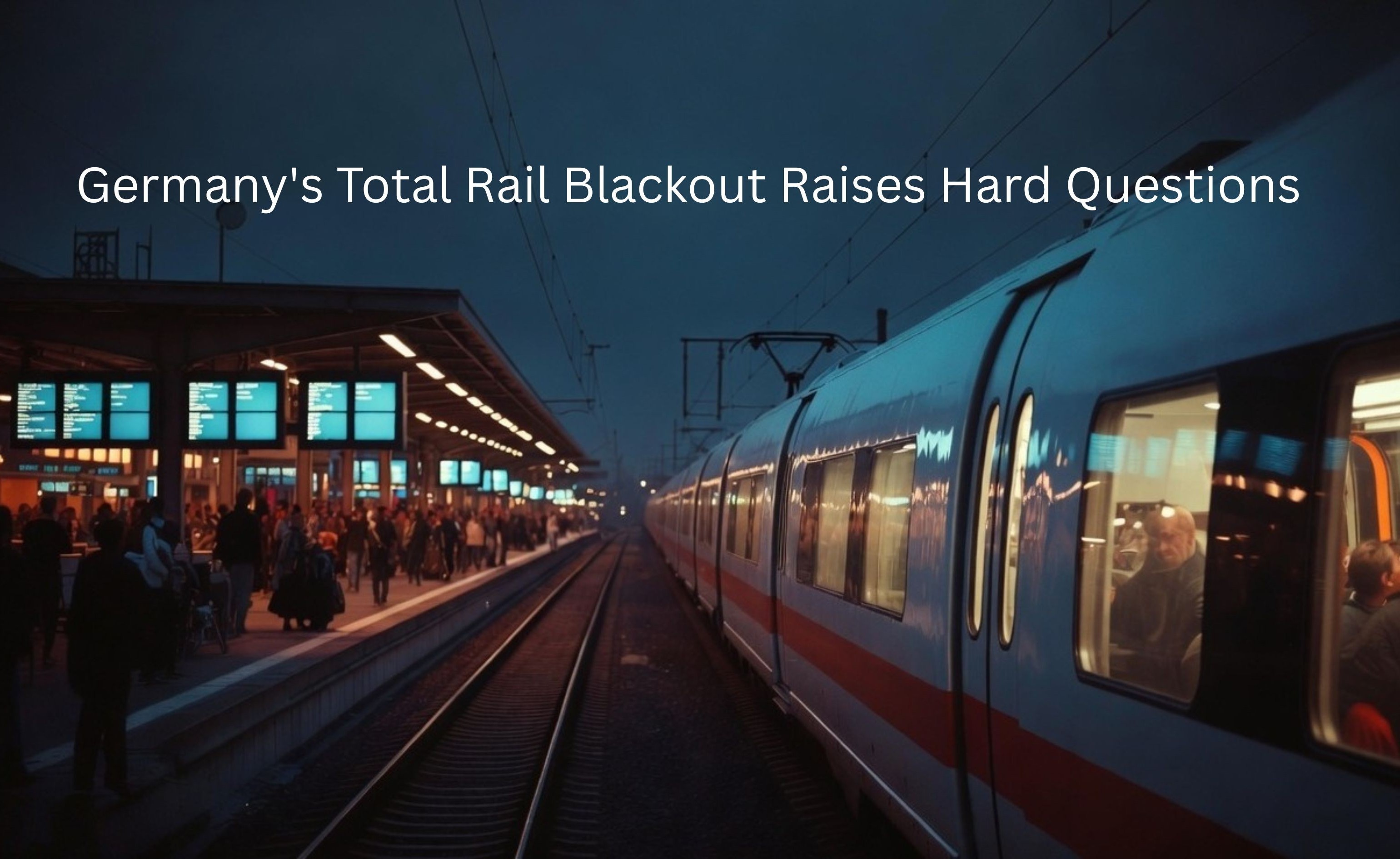
It was supposed to be a routine night's work. Engineers at Deutsche Bahn, Germany's national railway operator, were carrying out a scheduled replacement of a technical component in the GSM-R system — the digital radio backbone that keeps Germany's trains talking to their control centres. Somewhere in that process, something went wrong. And when it did, every single train in Germany stopped.
Not some trains. Not trains on one line, or in one city, or in one region. Every train, everywhere in Germany, at around 10 p.m. on Tuesday night, came to a halt and stayed there.
The Silence That Followed
GSM-R — Global System for Mobile Communications for Railways — is the nervous system of modern European rail operations. It carries voice and data between drivers and traffic controllers, authorising movements, relaying instructions, keeping the network alive. When it fails, rail safety protocols are unambiguous: without confirmed communication, trains do not move. There is no workaround. There is no manual override that keeps 50,000 daily train movements flowing. There is only stillness.
For nearly three hours, Germany's stations filled with stranded passengers who knew less than they expected from one of the world's most admired rail systems. Departure boards at Berlin, Frankfurt, Munich and Hamburg showed nothing useful. Staff at information desks, to their credit, were honest — they had little more to offer than the passengers themselves. At Cologne alone, around 200 passengers had to find overnight accommodation. One American traveller at Berlin's central station, trying to get back to Munich, summed up the evening simply: the conductor was kind, she said, but candid — he didn't know when they would move, or whether they would at all that night.
Deutsche Bahn CEO Evelyn Palla said the situation was eventually stabilised using an emergency backup system, shortly before 1 a.m. Full services resumed through Wednesday morning, with some residual delays.
A Routine Job That Wasn't
By Wednesday, the picture had become clearer, and more embarrassing. Philipp Nagl, head of Deutsche Bahn's infrastructure arm DB InfraGO, confirmed that the outage appeared to have been triggered by the planned replacement of a technical component — scheduled maintenance, in other words, not an external attack. Security authorities ruled out sabotage. German broadcasters SWR and rbb, citing railway employees and security sources, linked the failure to a software update that did not go as planned.
"We are analyzing with the highest priority how exactly this led to the fault," Nagl said in a statement, adding an apology to passengers. The precise nature of the component, and exactly what went wrong, has not been publicly disclosed.
Oliver Krischer, the regional transport minister for North Rhine-Westphalia — Germany's most populous state — did not mince words. "That all rail traffic in Germany comes to a halt because of a technical defect," he said, "is a new low in already poor operating quality."
One Point of Failure, an Entire Nation's Trains
What Tuesday's outage exposed is a structural reality of modern digital rail systems that rarely gets examined until something goes wrong: the degree to which a single communications layer, running on a single standard, underpins the movement of an entire national network. GSM-R is not unique to Germany — it has been rolled out as a common standard across 38 countries, including every EU member state, since 2000. A failure of the kind that hit Deutsche Bahn on Tuesday night is, in theory, a failure that could hit any one of them. Yet it is the European model of deep, uniform digital integration across a single continental standard that converts one component-level fault into instantaneous, total national stillness.
That is not a comfortable thought. Europe has spent years positioning rail as the sustainable, reliable alternative to short-haul aviation — a network of high-speed corridors, punctual intercity services and seamlessly connected regional lines. The reality, as Tuesday's events in Germany and last week's fatal collision near Bedford in the UK illustrated in very different ways, is that European rail infrastructure is under pressure from multiple directions simultaneously — ageing physical assets in some places, under-tested digital dependencies in others, and years of underinvestment working its way through systems that were built for a different era.
Deutsche Bahn has been in the middle of a major, disruptive infrastructure overhaul for exactly this reason — trying to catch up after years of neglect. That the overhaul itself triggered Tuesday's outage is an irony that will not be lost on the passengers who spent Tuesday night on station benches.
What Comes Next
Services across Germany were running largely normally by Wednesday morning, and Deutsche Bahn says it has identified the cause. Whether the full explanation, when it comes, will be sufficient to satisfy a travelling public — and a political class — that has grown increasingly frustrated with the network's reliability is another question. Germany's railway punctuality has been declining for years, and the trust that comes with operating what was once held up as one of the world's gold standards in rail is not easily rebuilt on the back of a Wednesday morning press statement.
For now, Deutsche Bahn is investigating. Germany is watching. And the rest of Europe — whose trains run on the same communications standard, the same ageing infrastructure, the same assumption that the system will hold — is perhaps watching too.
Also read: Driver Killed, Toll of Injured Rises After Train Collision Near Bedford, UK