
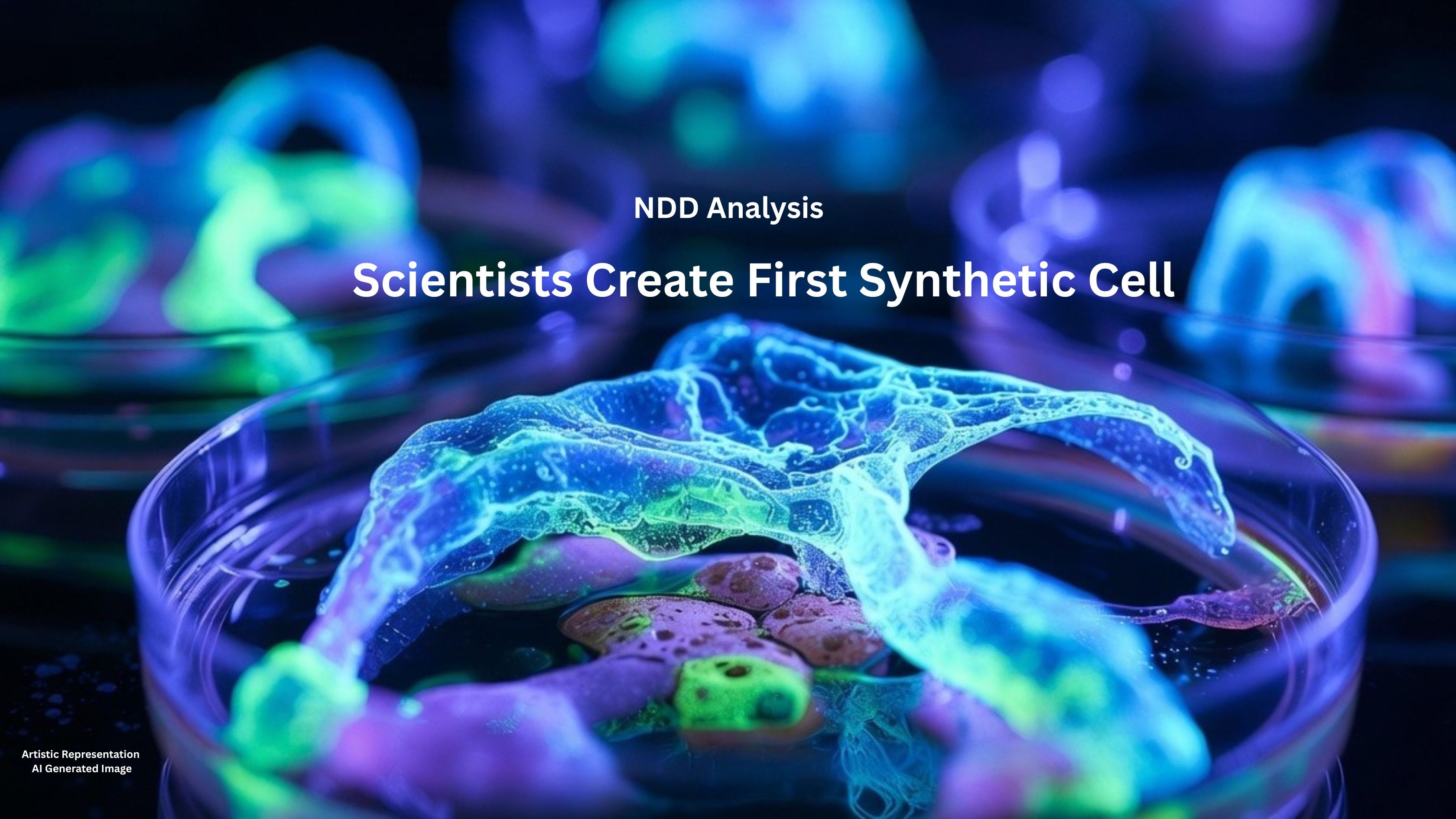
It looks vaguely like a potato. It is built from chemicals assembled in a laboratory. It is not alive — its creators are careful to say so. And yet SpudCell, the synthetic cell unveiled by a University of Minnesota team this week, can do things that until recently belonged exclusively to the living world: it feeds, it grows, it copies its own DNA, it divides into new generations, and it competes with other cells when resources run short.
That is not a small list. It is, in fact, the complete list of what biologists consider the core behaviours of a functioning cell cycle — and for the first time in history, scientists have replicated all of them in a single synthetic system built entirely from scratch, using nothing but known chemistry.
What SpudCell Actually Is
The creation of associate professors Kate Adamala and Aaron Engelhart, SpudCell is not a modified bacterium. It does not contain any repurposed living material. It is assembled, piece by piece, from individual chemical components.
At its core is a lipid membrane — the same basic architecture that surrounds every living cell. Inside that membrane sits a genome encoded in DNA, along with the molecular machinery needed to read those instructions and convert nutrients from the surrounding liquid into useful materials.
The result is a system capable of what the research preprint describes as “selection, genome replication, growth, resource acquisition via feeding, and genetically encoded division.” In short: SpudCell does what cells do.
Adamala, who named the project after noticing the cell’s passing resemblance to a potato, is precise: “We’ve replicated in chemistry what only used to be possible in biology. The complete set of behaviours of a cell. It proves that the most fundamental functions of life — growth and replication — do not need a mysterious magical spark.”
She is equally clear that SpudCell is not being claimed as alive. What the team has shown is the minimum set of chemical conditions under which life-like behaviour can emerge from non-living components.
Context: Building on Earlier Advances
This breakthrough builds on earlier foundational work in the field. In 2024, researchers at the University of North Carolina led by Ronit Freeman created artificial cells with functional, programmable cytoskeletons using peptide-DNA technology. Those cells could change shape and respond to their environment. You can read more in the UNC news release and the original Nature Chemistry paper. SpudCell takes the next major step by demonstrating a complete, self-sustaining cell cycle — including replication and competition — in a system built entirely from defined chemical parts.
Why This Matters
The significance of SpudCell operates on at least three distinct levels.
Philosophically, it pushes the boundary of what we thought required the irreducible complexity of life. By assembling a system that exhibits every functional behaviour associated with a living cell using only chemistry, it moves the question of “what is life?” from metaphysics toward something scientists can study and engineer.
Historically, it offers a new experimental window into the origins of life. Life on Earth began from chemistry billions of years ago. SpudCell demonstrates that life’s defining behaviours can emerge from assembled non-living components — bringing that ancient transition into the realm of laboratory study.
Practically, the implications are potentially transformative. The world currently produces medicines, industrial chemicals and advanced materials either by reprogramming natural living cells or through energy-intensive industrial processes. SpudCell points toward a third path: synthetic cells designed from the ground up to produce specific outputs, without the limitations of natural biology or the environmental costs of conventional chemistry.
Relevance for India
India’s growing synthetic biology ecosystem — spanning IITs, NCBS-TIFR, CSIR laboratories and several startups — is well positioned to engage with this frontier. Programmable synthetic cells could eventually support affordable, targeted drug delivery systems, low-cost diagnostics, and sustainable biomanufacturing relevant to Indian healthcare and agricultural needs.
The open-source approach taken by the Minnesota team (through the Biotic platform) also aligns with India’s emphasis on accessible and collaborative science. As global efforts accelerate — including the SynCell Asia Initiative’s 10-year roadmap — India has a timely opportunity to build domestic capacity in this strategically important field while developing appropriate regulatory and ethical frameworks.
What Comes Next
The team is publishing its methods openly so researchers worldwide can build on the work rather than start from scratch. Adamala has been candid about remaining challenges, including better metabolism, more robust division, and eventually ribogenesis — the ability of a synthetic cell to produce its own protein-making machinery.
The field is already describing this preprint as a turning point — not because SpudCell is ready to replace natural cells in industry, but because it has made a set of challenges that once seemed indefinitely distant feel, for the first time, like solvable engineering problems.
A bag of chemicals that behaves like a cell. Named after a potato. It may be the most important thing published anywhere this week.